
Flying "Off-Road"
Another Airplane Story

I have a tremendous respect for African bush pilots. They fly under some of the absolute worst conditions imaginable. Often, they’re misfit toys who don’t seem to fit in anywhere else in the world. Many simply don’t want to be glorified bus drivers at 35,000 feet. They want some excitement and challenge… and maybe a little danger. And Africa seldom disappoints.
I recall one time escorting a couple of ladies to the Upper Nile to visit some of the communities they had been supporting through my NGO. Both had never been to Sudan (or Africa) before. And it was August— smack dab in the middle of the rainy season— when most of South Sudan turns into a big swamp twice the size of Texas.
We had a very successful trip and managed to stave off malaria from the swarm of mosquitoes which nightly tried to break into our tents. Our bush pilot, John, was right on time to pick us up. Since there was only four of us on the plane, John asked if it would be alright to stop and pick up one additional passenger. “Sure,” I replied. “What’s the harm?”
The place where we had to fly was called “Loquendelay,” which I believe is roughly translated “only idiots land here during the rainy season.” John had radioed ahead of time to check the condition of the runway. The guys on the ground assured him the airstrip was as dry as a bone. But flying over the area, I wasn’t convinced.
When we landed, it felt like all the tires went flat at once. I looked out the window to see mud flying everywhere. I then looked at John. He wasn’t happy. To make matters worse, when our passenger walked out to meet us, he was the biggest Kenyan we’d ever seen. He was built like a flanker for the South African Springbok Rugby Team.
To compensate for the weight and runway, John put our Kenyan giant up front, and the rest of us moved our seats to the rear of the Cessna. We then taxied to the very end of the runway and John gave it full throttle, with full flaps, and holding the brakes until he could hear every horse in the engine screaming for dear life. When he released the break, we leapt forward and started tearing down the runway, spraying mud everywhere. By the time we got to the end, we were still too slow, so John reversed the throttle, slammed on the brakes, and swung the plane around before we hit the trees at the end of the airstrip.
Through this ordeal, my two lady friends were sitting very quietly. Their eyes were closed and I supposed they were making many unspoken vows to the Almighty in exchange for their safety.
John said we should give it another go. So, again, he fired up the engine to full throttle and we hurled down the runway. No dice. We were still too heavy. John looked at our Springbok. “You gotta get off, my friend.”
Now considerably lighter, John tried again. And again, we reached the end of the strip too slow and John had to slam on the brakes. By this time, mud had caked on the fuselage of our plane, adding weight and making it unlikely we were going to depart “Loquendelay” until mid-November.
“I think we’ll try once more because the right side of the strip looks a little drier.” By this time, our two lady passengers had grown very white in addition to very quiet. For the fourth time, John went full throttle. And we made it! -- barely. I was sure our tires brushed the thorn trees at the end of the runway.
When we arrived back at base, everyone starred at our plane, which looked like we had flown through a mud pie. This was true off-road flying.
The continent of Africa still contains several locations where one can get really “stuck.” When I consider the state of air transport, it is entirely possible that before I die, I’ll be flown by a pilotless aircraft. This means the intrepid, swashbuckling “Han Solos” I’ve known through the years truly are “endangered pleasures,” because they have been a genuine pleasure to know and I count it a privilege to have been along for the ride in sharing some of their adventures.
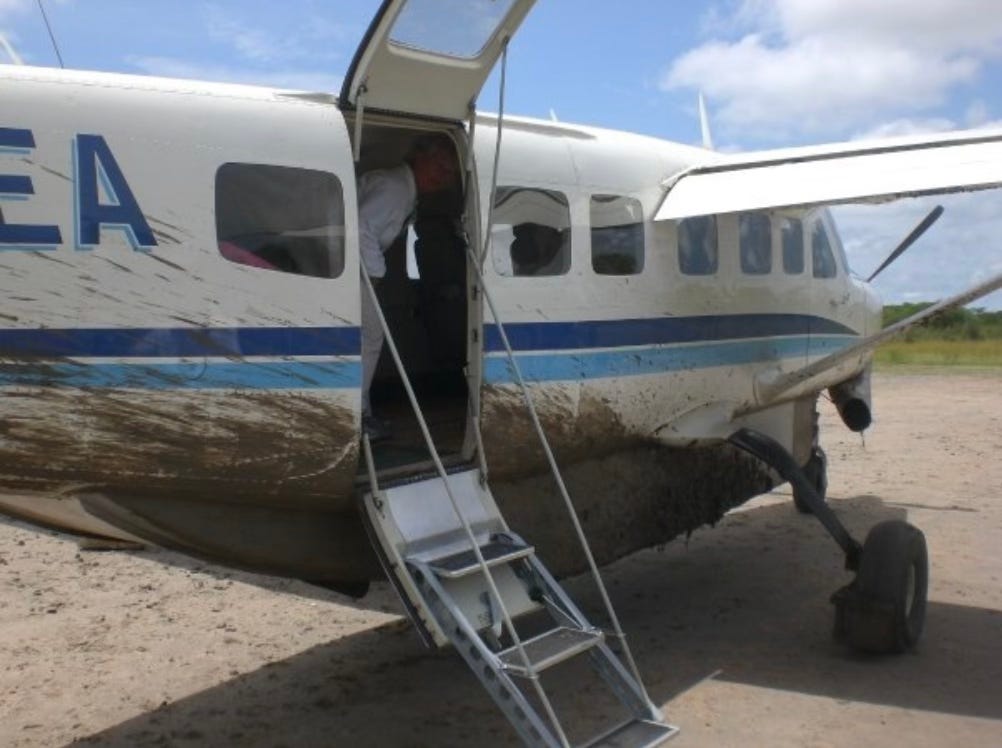
Our plane (yes, the actual one)