
Papa's Lesson
I'll always remember that day...

It was early. Really early. Springtime in the Wiregrass region of Alabama can feel like a steam bath once the sun comes up and starts cooking the morning mist which hovers over the gentle hills where our little property in Dale County stood. It was a pretty piece of land surrounded by field and forest. I recall that wild blackberry bushes grew along the fence line of our neighbor’s pasture, often hiding water moccasins.
I didn’t like getting up early. Ever since Mama and Daddy had decided to homeschool us kids, we didn’t have to catch a 6am bus.
But my grandfather, Papa, was going to change that.
He pulled up our drive in his little brown Mazda pickup. I loved that truck. When Papa would take me to his “Coffee Club” at McDonalds in Enterprise (again, VERY early), he’d let me shift the gears while he steered. But on this day, something was strapped to the bed of the truck; something I’d never seen before.
He parked the truck and got out, pausing just long enough to remove his walking shoes and replace them with big leather boots. The rest of him looked like the grandfather I’d always known: an old man of average height, slightly stooped, always wearing Dickies jeans, long sleeve plaid shirts, and an Auburn Tiger trucker cap.
When he let the tailgate down, I knew I was in for it.
“Matt (pronounced “May-yut” in his North Carolina tobacco farm accent), your Mama wants you boys to learn about biology. Come meet your new teacher.”
“What is it?” I inquired.
“Genesis 3:17.”
“Huh?”
“In the sweat of thy face shalt thou eat bread, till thou return unto the ground; for out of it wast thou taken: for dust thou art, and unto dust shalt thou return.”
Papa was always a King James kind of Christian.
“This is a Troy Bilt, self-propelled rotor tiller. You and your brother are gonna plant a garden. Today. Go put on your dirty clothes.”
My younger brother, Jon, was called “Cotton Top” by Daddy because of his strikingly blond hair. But I think my hair turned whiter than his as I looked at that big red machine in the back of Papa’s truck.
“Let’s first go pick a spot,” said Papa.
We walked through the back yard and Papa surveyed the area. “I think we should put the garden a little ways from that big pecan tree, where it will get more sun. What do you think?”
“Sure, I think that will be fine,” I replied, as though I knew anything about selecting garden spots!
Papa smiled.
We offloaded the tiller, and Papa checked the fuel and oil levels. “Okay, Matt, I’ll hold the throttle and you pull the rotor chord.”
I tried pulling the cord, but nothing would move. I tried with both hands. Still nothing.
Papa laughed.
“Here. Lemme do it for you.” One swift pull later, the engine choked to life.
We positioned the tiller to make the first row, and Papa showed us how to engage the rotors, set the depth, and keep the rows straight.
“This land has never been broken, so it’s gonna be hard,” said Papa. “You’ll be wrestling this machine for the first few passes.”
Boy, he was right! Although the rotors were set very high, the moment they hit that tough wiregrass, the tiller jumped around like a bucking bronco. It was all we could do to hold on for dear life.
Papa laughed again.
Every couple of rows, we had to stop the tiller and remove clumps of grass tangled on the rotors. But two hours later, there were several nice, deep rows— mostly straight. We were covered from head to toe in sweat and dirt, our palms filled with blisters.
We took a break in the shade, and my sister brought us some ice water.
“Matt, when I was your age, my Troy Bilt tiller was called a mule. I had to stand behind holding the plow and try to keep that mule on the straight and narrow. It wasn’t easy. That tiller may be tough, but at least it doesn’t have a stubborn will like that old mule!
“I can imagine,” I replied.
“Well, now you can,” smiled Papa, as he took another sip and decided to change the subject.
“You know the 5th Commandment says we’re to honor our fathers and mothers that our days may be long in the land God gives us?”
Papa, a good Southern Baptist, liked to insert Bible lessons into practically every situation in life.
“Yes, sir, I know.”
“I’m sure you do. But what does it mean?”
“I reckon it means to do what your parents tell you to do.”
“Well, not exactly. My parents have been dead a long time, but I try to honor them every day by the way I live.
“And honoring parents doesn’t just mean literal parents, but pretty much all those who came long before you.”
“You mean our ancestors?”
“Yeah.”
“But what about the bad ones?”
“Oh, especially those,” Papa replied.
“Huh? I don’t understand.”
“The commandment doesn’t say honor only your good fathers and exceptional mothers. There’s no conditions.”
“But why?” I questioned. “How can we honor people who did bad things, even if they’re related?”
“Well, that’s the Gospel in a nutshell. Jesus loved sinners. Died for sinners. He showed us great honor by calling us ‘friends’ while we were still His enemies. His example frees us to do the same for others— especially people we don’t like. It’s easy to love good people.”
“Yes, sir. I guess.”
“Son, it may be hard for you to see right now because life is pretty simple for you. There are good guys and bad guys. Black and white. Justice and injustice. But people are complex and messy. You’ll see that the longer you live.”
“Hmm.”
“Honoring parents doesn’t mean agreeing with everything they say or do. It just means we need to appreciate that we are who we are today because God chose to write our story using messy, imperfect people. And by doing this, He shows us how love and patience works.”
“I’m still a little confused.”
“Our parents are our role models and sometimes idols, and when they fail, it hurts a lot. We can take it hard and become bitter and angry, causing us to lose our way and isolate ourselves for fear of being hurt again… or becoming like those we hate.
“But this can feed arrogance and pride. We start to think we’re better than those who came before us. We become easily offended and impatient with the failures of others. We forget how to love and become hard-hearted, just like the ground you’re trying to plow.
“That hard ground is like our pride. It must be broken before we’re any good to anyone— especially ourselves. And some of the best tools I’ve found for breaking pride aren’t a Troy Bilt rotor tiller— it’s gratitude and honor. If we can honor even our not-so-perfect parents, we’ll fully appreciate and enjoy the inheritance we’ve received. We learn how to love.
“Huh. Okay. I guess that makes sense.”
“Of course it does, boy. It’s in the Bible!”
“Papa, when do we actually plant the garden?”
“Oh, that’s later. You still have to go a few more rounds with the tiller before the ground will be ready to produce… kind of like me with you.”
“I was afraid you were going to say that.”
Papa laughed. “Well, get to it.”
“Yes, sir. I suppose I should…”
“We all should, son. We all should.”
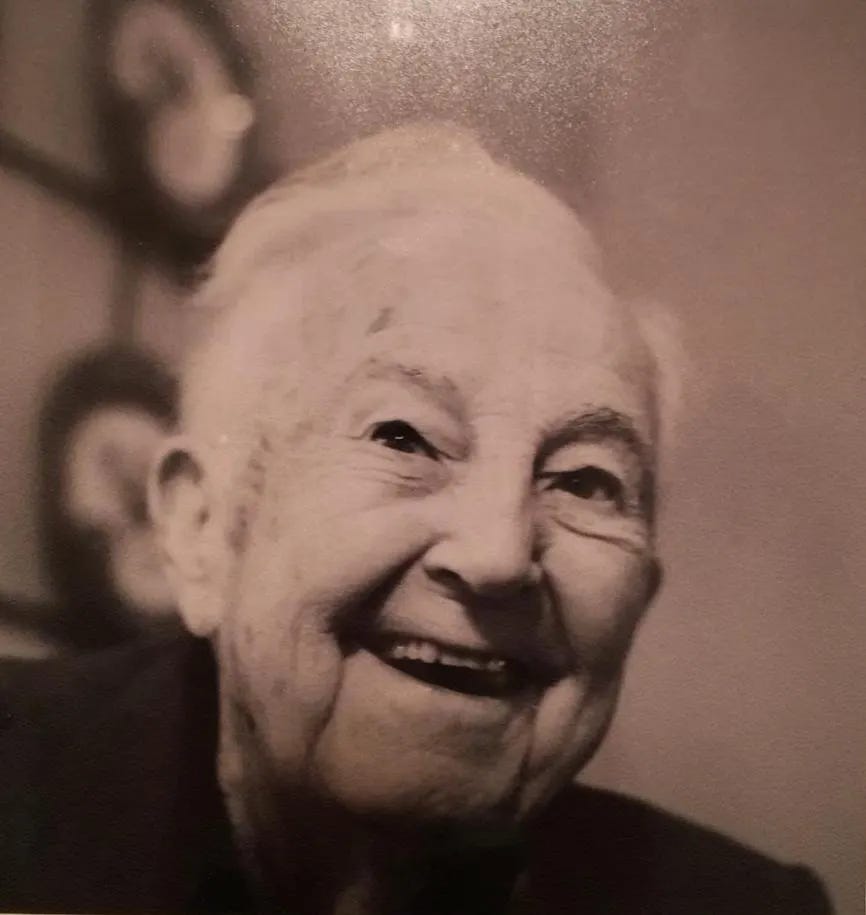
Papa
“Love is patient, love is kind. It does not envy, it does not boast, it is not proud. It does not dishonor others, it is not self-seeking, it is not easily angered, it keeps no record of wrongs. Love does not delight in evil but rejoices with the truth. It always protects, always trusts, always hopes, always perseveres. Love never fails.” I Cor. 13:4-8a