
When Christmas Hurts

Early December in Southeast Alabama is always a weather enigma. There is no possible way to know how to pack if you’re visiting from out of town. One week might be cold and wet with freezing temperatures in the evening, and the next week can literally be sunny and in the upper 60s.
In early December this year, it was cold, wet, and gray— my FAVORITE winter weather. I like it, because it means I can pull my tweed suits out of mothballs and actually wear them a day or two. Tweed is a remarkable invention. It allows the wearer to carry around his own biosphere. It could be raining, cold, and blowing a gale, but the man wearing tweed feels nothing but perhaps a little redness on his cheeks and nose. The rest of him remains dry and a comfortable 98.6 degrees Fahrenheit.
When the weather is particularly bad this time of year, there are few people outside. Downtown is generally congested with cars moving to and fro, passengers hopping out from time to time to race toward a shop door and avoid the environmental slop outside. I, on the other hand, insulated from head to toe, love to walk outside and breathe the fresh air—always so clean in winter.
I think we all tend to associate the darkness and cold with stillness and silence, affording the mind some time for reflection. Perhaps this is one reason why Christmas can often be a difficult season for many. We all know life is punctuated with sadness and suffering, and if it occurs during the Christmas holidays, the stillness and silence of the season afford more opportunities to dwell on the pain and amplify feelings of melancholy.
I remember the loss of a beloved grandmother on Christmas Eve more than 20 years ago, and, even today, I think of her often and dream of visiting her on Lakeshore Drive. Christmas was so joyful in her home. After dinner, she’d always ask me to play her piano. It was a small upright Wurlitzer in the corner of the white-carpeted living room us kids were never allowed to enter except on Easter, Thanksgiving, and Christmas.
My grandmother would sit on a little cushioned ottoman next to the piano so she could watch as well as listen to her grandson play. Her favorite request was the old hymn “What a friend we have in Jesus.”
What a friend we have in Jesus,
All our sins and griefs to bear!
What a privilege to carry
Everything to God in prayer!
O what peace we often forfeit,
O what needless pain we bear,
All because we do not carry
Everything to God in prayer!
A couple weeks ago on a Saturday, I was walking to our restaurant downtown on a particularly gray and bitter day. The famous monument in the center of town was covered in garland and red bows for the season and all the shops decorated to give visitors the distinct impression they were in Dr. Seuss’s fictional “Whoville”—not Enterprise, Alabama.
I entered our cozy shop and sat down in one of the high-back chairs next to the front window so I could watch life go by as I drank my morning coffee. Sitting next to me on a couch was an old man from out of town. He was drinking silently, but upon seeing my unique “costume,” he assumed I must be the man in charge.
“Excuse me for bothering you, but are you the owner of this place?”
“You’re not bothering me at all, sir,” I replied, “and the answer to your question is a qualified one. I am not technically the owner of this restaurant, but I am married to her, so my coffee is significantly discounted…which must count for something.”
“Indeed it does,” he laughed. “My name is Ken Graham, and I was born at 211 Watson Street here in Enterprise in 1937.”
“Is that so?” I asked. “I’ve never been good with math, but I reckon that means you’re closing in on 90 years of age. Congratulations.”
“Thank you, sir.”
“You say you were born here, but I don’t recall seeing you in our shop before.”
“No, sir. I live in Florida, but still have family in the area I visit during the holidays. I haven’t lived in Enterprise since the 1940s.”
“It’s amazing how our hometown tends to boomerang us back time and time again,” I added.
“You are right. I like your shop. You know the history of this building, I presume.”
“Yes, sir, I do. This is one of the oldest buildings downtown. When you were a little boy, this was Martin’s Drug Store.”
“You’re right, sir. This was one of the most popular places in town for us kids, because it was where you could get an ice cream sundae, penny candy, and a cold Coca-Cola.*
[*Note: “Coca-Cola” in the Deep South is pronounced “Coke-Coaler.” Let the reader understand.]
“But I probably know something about this place that you don’t,” I replied. “Years ago, Mr. Martin closed his shop by locking the doors and walking away. For years the contents remained untouched — including all the inventory. Finally, all contents were purchased by Landmark Park in Dothan, and they built an old-timey country store and filled it with everything in Martin’s Drug Store. You can go to the park today and see exactly what this place looked like when you were a boy.”
“That’s very interesting,” Ken replied. “Now let tell you something about this place that you probably don’t know. And how could you? It concerns the day my life changed forever.”
I excused myself for a minute to refill my mug, because I knew I was in for a story. Mr. Graham then continued.
“During the war in 1944, there were not many young men in Enterprise. Most were somewhere in the Pacific or Europe. My father and his two brothers had just been called up, and I was living at home with my brother, mother, and grandmother.
“My mother’s name was Pearl, and she worked two jobs to support us kids and my grandmother. Granny had been blind since age 18 from glaucoma.
“Everybody had to work hard. But the worst job in town was held by the old man who rode the bicycle for Western Union, delivering telegrams. Everywhere he rode, a dark cloud followed him, because everyone knew what it meant when he stopped in front of their house.
“I remember the women would sit on their front porches shelling peas or shucking corn, and when the old man rode by on his bicycle, they would all stop and hold their breath until he passed. I distinctly remember my grandmother standing up and gripping the railing by the steps, staring blinding into the street and listening to the bicycle as it approached.
“One one occasion, the poor old man saw my grandmother and tried to reassure her. ‘Good morning, Mollie,’ he exclaimed, and my grandmother exhaled in relief. Then she whispered ‘Please, God, don’t let him stop at Mrs. Flowers’s home.’
“Although my mother worked very hard, she’d established a ritual with me and my brother so we didn’t feel neglected. Every Saturday, she’d take us to the Levy theater for a movie and then here for an ice cream sundae or a shake.
“One Saturday in early December—a day like today,—we were sitting right here at a table looking out this very window. All of a sudden, the old man rode up and parked his bicycle at the door. My mother screamed ‘No, God! No, God! Please, no, God!.’ We were the only ones in the shop.
“From that day on, our lives changed forever. Mother eventually remarried, and we moved to Florida. Life went on and has been full of adventure for me, with all its ups and downs. But I’ll never forget every detail of that day in December, and of this place.”
As Ken finished, his eyes were wet…and mine were, too.
Have we trials and temptations?
Is there trouble anywhere?
We should never be discouraged—
Take it to the Lord in prayer.
Can we find a friend so faithful,
Who will all our sorrows share?
Jesus knows our every weakness;
Take it to the Lord in prayer.
The problem with the Christmas season is not just the appalling commercialism which seems to get worse every year; it’s the tendency to dwell solely on the “cutesy parts.” You know, the furry farm animals, the drummer boys, the shepherds with their fluffy sheep, angels playing harps, the silent night, etc.
And because of this “Hallmark Christmas” emphasis, we don’t always know how to handle it when Christmas hurts.
“THE SECRETARY OF WAR DESIRES ME TO EXPRESS HIS DEEP REGRET THAT YOUR HUSBAND, PVT. MILBORN VICTOR GRAHAM WAS KILLED IN ACTION IN SERVICE TO HIS COUNTRY.”
While Christmas can hurt, it doesn’t mean it’s bad. We tend to see pain and suffering as wholly negative, and it’s true that, in a perfect world, it wouldn’t exist. But we don’t live in a perfect world. We do, however, live in a good world. And we all know something can be painful and, at the same time, still be very good. The pain of childbirth or a successful surgery are examples.
But the best example is the Passion of Christ. The pain and suffering and injustice of Christ’s execution was, at the same time, a very “good” thing for us. That bloody cross shows what incredible lengths the Son of God went through to be fully human. The incarnation wasn’t merely about taking on a human body, nature, and will. It meant taking on everything it was to be human in an imperfect world: the capacity for pain, suffering, and immense sorrow.
So, in a way, Christmas isn’t a celebration of the incarnation of Christ, but the beginning of the incarnation of Christ. Christmas was the entrance into the world of a God who was also uniquely and fully human. Mankind had fallen away from their Creator. They turned their back on him, caving into their own egos. But God is love, and “love never fails.” Love came to us as one of us to show us the way back to God. Back to love. And that way is a path full of joy, but also pain and often intense suffering.
It never really dawned on me until much later in life that when Jesus told his disciples to “pick up your cross and follow me,” it was before his own crucifixion. Imagine how shocking this statement was to the disciples at the time! But imagine how more shocking it was when they saw Jesus carrying his own cross a few months later. It was as if Jesus was saying “As humans in a fallen world, we all have crosses to bear. Let me show you how it’s done. Follow me.”
Yes, Christmas can be cute. But it can also hurt really bad. And if the Christmas season hurts for you, like it hurts for Ken Graham, you’re not being a Grinch or a Scrooge. The Christmas spirit is still for you. In fact, it’s especially for you. Christmas is a yearly reminder that your pain, suffering, and loneliness are shared by Someone who can infinitely relate to it all— because He went through it all so He could be with you in your sadness. He could participate in your pain. He could share in your suffering. “Jesus wept.”
Are we weak and heavy-laden,
Cumbered with a load of care?
Precious Savior, still our refuge—
Take it to the Lord in prayer.
Do thy friends despise, forsake thee?
Take it to the Lord in prayer!
In His arms He’ll take and shield thee,
Thou wilt find a solace there.
Merry Christmas.
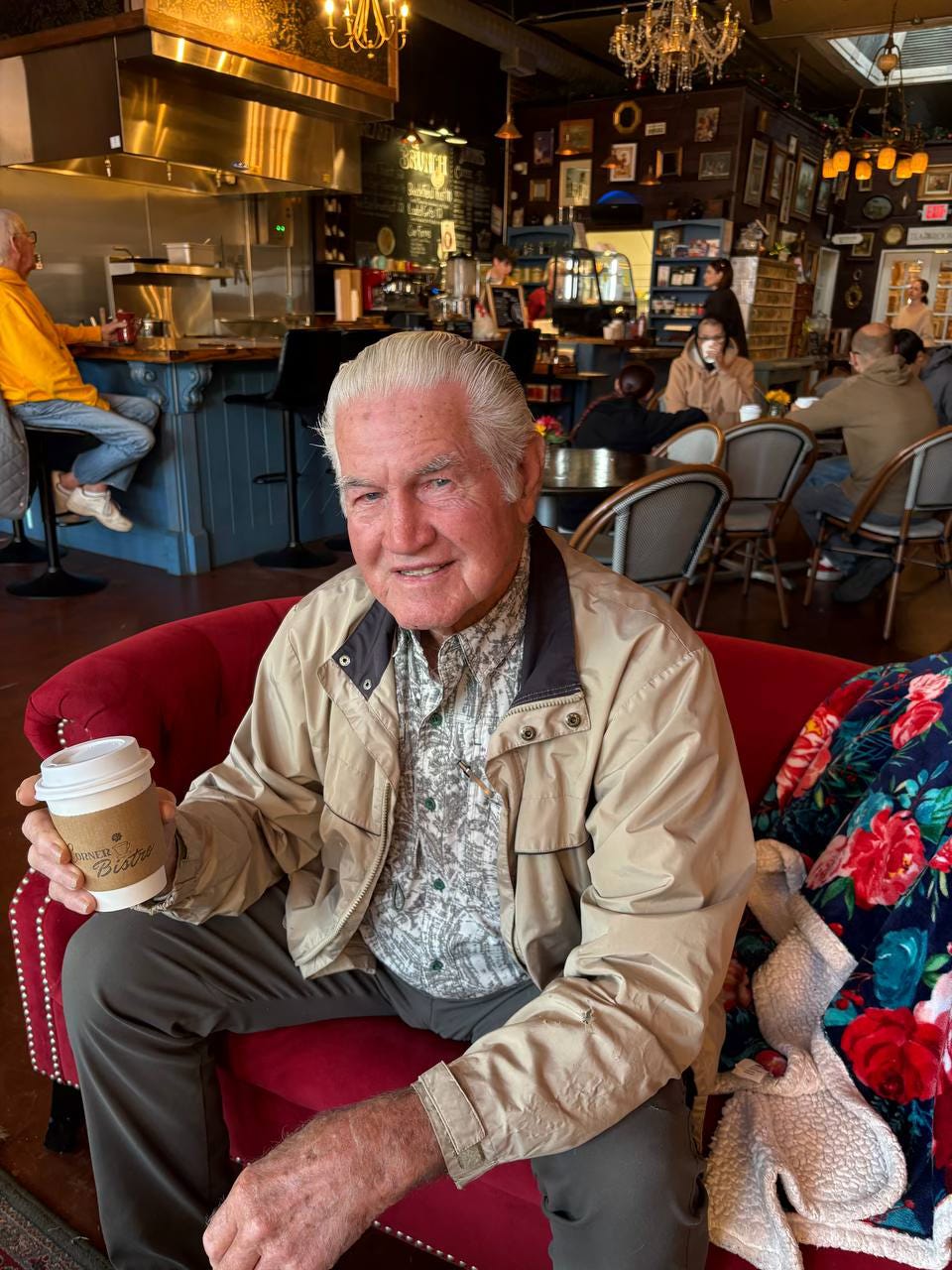
Ken Graham